Happy Tongue: Happy Body
/
Sensing the soft totality of my tongue helps me remember that the rest of my body, my being, can also soften and fill, can hum and flow. Can dance.
Read MoreSensing the soft totality of my tongue helps me remember that the rest of my body, my being, can also soften and fill, can hum and flow. Can dance.
Read MoreYour own experience tells you that opening can be sustained only in the presence of support. Balancing your alignment with gravity with awareness of normal joint function affords strength without effort, openness without defense, support without closure. Within your mountain is a beating, breathing heart.
Read MoreA free-wheeling, leisurely conversation with my new Pilates friends.
Read MoreWhen you’re feeling self-confident and assertive, there’s an automatic uplift to your chest, spine and neck—your posture automatically organizes itself for the better. But no one feels terrific all the time, right? By teaching yourself the physical sensations that correspond to a good mood, you can use your body-mind connectivity to good advantage. Body awareness helps you cultivate positive outlooks in humdrum situations…
Read MoreAs a Rolfing® practitioner, I've observed that tension in the elbows affects the whole body. Habitual flexion there, however slight, pulls the upper arm forward in its socket, starting a chain reaction that pulls the shoulder blades forward, and the collarbones and chest down, and the neck forward. Elbow tension often corresponds with flexion in the spine just behind the diaphragm, and that interferes with fullness of breath. The postural end result feels, and certainly looks, nothing like the upper crust ladies of Downton…
Read MoreThanks to a reader of The New Rules, for inciting me to write again about breathing. It’s a HUGE topic, so this post is a distillation. Here’s my reader’s query: Here in Germany, singers, yogis, and tai chi practitioners are hotly debating the possibility of two types of people with different body organization. The focus lies on differences in breathing: exhalers and inhalers. In my understanding, their spatial organization corresponds to what you call earth-orienting and space-orienting, respectively. In everyday breathing…
Read MoreNot long ago Katy Fox, an artist and yoga instructor in San Francisco, contacted me because she had found The New Rules of Posture useful in her work. She also wanted to share her own vision with me. Katy has a huge vision–nothing less than the re-embodiment of our culture.Sensibly, she’s starting small. The week following our conversation she launched her first embodied public space: Soundscape of the Human Heart. She was pretty jazzed about this when we spoke…
Read MoreI love my accountant. The walls of his office display a 40-year collection of IRS cartoons, and he does everything he can to keep our yearly meeting light. But there’s nothing like an hour’s contemplation of tax code intricacies to make your head spin and put kinks in your center line. Money, when you have to part with it, compresses the body. Which is how I walked out of the office…
Read More“My tongue?” you say. “What does my tongue have to do with my posture?” Actually, quite a lot…
Read MoreMy bare feet go flap-flap-flap on the kitchen floor before breakfast. The sound of it rests along the back wall of my attention as I flick my mind over the tasks ahead for this day. And muse about how much nicer it would be to laze on the couch with a book instead. It’s been triple digit weather in Los Angeles for way too long, and such heat wears a body down!
Read MoreYour midline exists before you are born. It’s visible as the “primitive streak” by the 14th day of pregnancy…
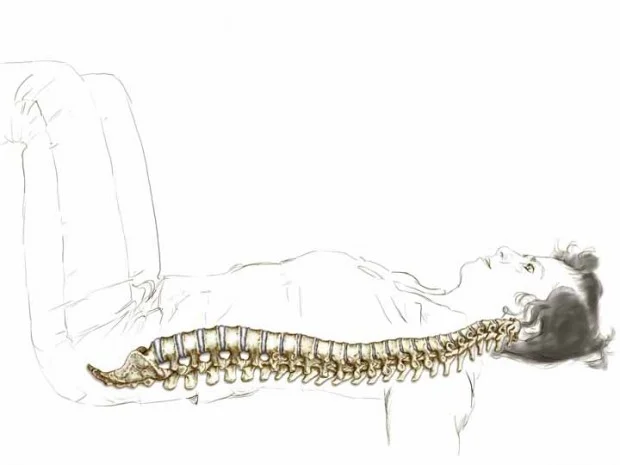
Read MoreBegin in a seated position as you did in Part 1 of this exploration. Imagine that each of your vertebral bodies contains a light source. When you inhale, the lights brighten; when you exhale, they dim. Imagine that the 24 vertebrae and sacrum can each project a distinct beam onto a wall a few feet in front of you. Each time you breathe in, your spine subtly extends, and that makes the light beams on the wall spread slightly apart from each other—visualize that happening. Breathe slowly and steadily. After every exhalation take a second to sense the weight of your body on the chair and your feet on the floor…
Read MoreA great many well-meaning teachers, psychotherapists, gurus, and friends have suggested to me or to others that when we’re under stress we need to take a deep breath.
I don’t agree.
Read MoreIn my DVD, I speak several times about the importance of propelling the body forward with the back leg and foot, allowing toe-off to be complete. It’s common, in places where space is at a premium (e.g. crowded sidewalks, corridors between work cubicles, small kitchens) for us to pull ourselves forward with the leg that swings forward, rather than propelling our bodies forward from the back leg. When the body is drawn forward from the forward heel, the hamstring muscles don’t complete their potential for movement which is to extend the hip enough to take the leg behind the body. When the hip doesn’t fully extend, the hamstrings are robbed of the opportunity to let go during the swing phase of the walk. This is the scenario of perpetually tight hamstrings…