Tensegrity Tongue
Your tongue is a muscle, right?
That’s what I thought before learning that there are sixteen muscles in the tongue. Half of them—four on each side—are muscles that move your tongue in and out of your mouth and wave it around in front of your face when it’s out. The other eight are intrinsic muscles that move your tongue within your oral cavity as you speak to or try to dislodge a bit of trapped broccoli.
To get a sense of your tongue’s capacity for exotic choreography, simply repeat Mary Poppins’s favorite word: “supercalifragilisticexpialidocious.” Try to memorize the movements of your tongue as you say this several times. Speech demands some fancy footwork from your tongue along with coordinating the movements of your lips, throat and respiratory muscles. Not to mention the new movements it must master when you learn a second language.
Where does your tongue go...
...when you’re not speaking or eating? Where is your tongue right now as you read this?
Over several decades I’ve taught two contradictory ways for the tongue to rest, both, I now realize, incorrect. First, I taught that the tongue should lie on the floor of the mouth. This seemed logical: our bodies yield to the force of gravity as we stretch out on the bed for a nap. Shouldn’t our tongues also rest downward? Years later, I taught that the tongue should lightly touch the roof of the mouth like a soft carpet. That was better, but still not right.
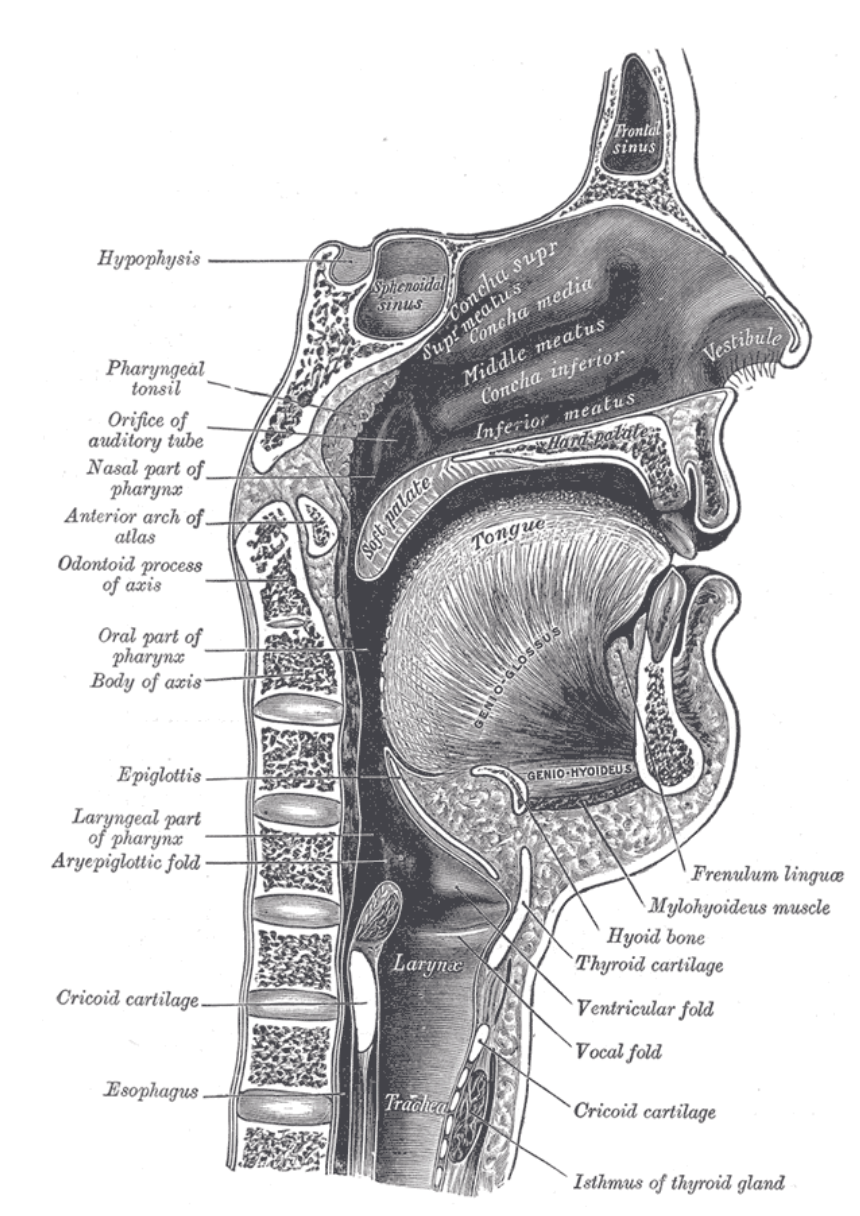
The optimal way for the tongue to rest is for all sides of its surface to touch all surfaces inside the teeth. The upper surface of the tongue rests upward to carpet the roof of the mouth, the lower surface settles onto the floor of the mouth, the sides of the tongue rest outward, touching the molar teeth, and the back of the tongue leans against the soft palate.
Tensegral balance within the oral cavity
You just tried it, I hope. If sensing the back part is elusive, try noticing what happens when you swallow. Just at the end of swallowing, there’s a feeling as though the back of your tongue is being gently suctioned against your soft palate. This is actually what is happening. That tongue-to-palate suction temporarily closes off your oral cavity from your pharynx, ensuring that air and food each find the correct passageway.
It may be helpful to know that the front two thirds of your tongue is innervated—hooked up with your brain—differently than the back third. Nerves that affect the front two thirds are involved in eating and speaking. The back of your tongue supports respiration, specifically nasal breathing and innervated by the vagus nerve.
When the tongue expands in all directions, it’s neither lax nor stiff but has a comfortable amount of tone or resting activity. Your closed soft palate and closed lips create a negative pressure within the oral cavity that supports the tongue’s expansion without need for muscular effort. There is a perfect balance between the tongue swelling out and its container pressing in. This balance of forces between compression and tension is an instance of the tensegrity principle at play in the body.
An infant’s tongue rests this way. If this new possibility for your tongue at rest feels oddly familiar, it may be that you are remembering how it felt to you so long ago.
What your tongue is doing can have surprising ramifications all the way down to your toes. After experimenting with the sensation of omnidirectional tongue—and once sustaining it feels easy—begin to notice other phenomena in your body.
Consider how your tongue’s new way of resting affects
Nasal breathing
Movement of your respiratory diaphragm
Sensation in your pelvic floor
Awareness in your feet
Ease of movement
Balance
I’ll have more to share with you about the tongue in another post. Meanwhile, if you experiment with just this sense of having an omnidirectional tongue, you’ll find that your tongue has much to teach you.
© 2025 Mary Bond
Thanks for reading and for sharing!